
What Is the Best Material for a Wardrobe in Kerala?
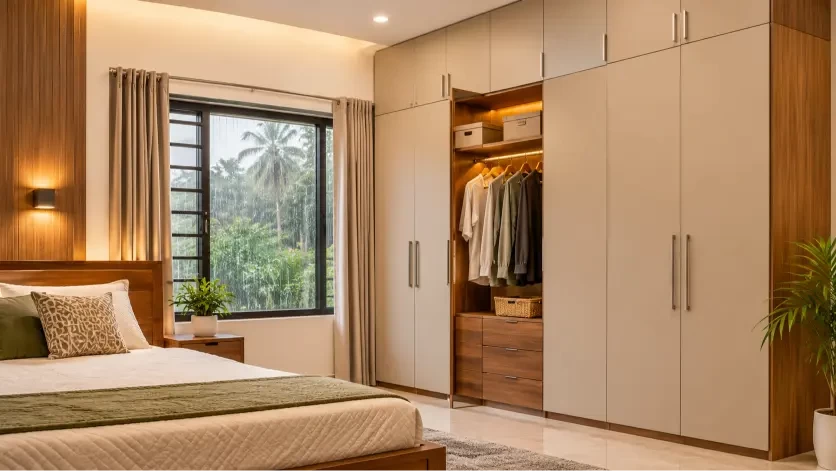
For most Kerala homes, I recommend BWP (boiling water proof) plywood for the wardrobe body, finished with a laminate or acrylic shutter and stainless steel hardware. If your budget is tighter, BWR plywood or HDHMR board can work well in drier rooms. I’d steer clear of ordinary MDF and particle board anywhere humidity creeps in.
Why Kerala is tough on wardrobes
We get months of high humidity, relentless monsoon rain and, near the coast, salt in the air. Wood-based boards soak up that moisture, swell and lose strength. Add termites, which love damp timber, and an average wardrobe doesn’t stand a chance. When I judge wardrobe material for Kerala’s climate, I look at three things: moisture resistance, termite protection and how well the board holds screws over time.
Wardrobe materials compared
Material | Moisture resistance | Termite protection | My verdict |
BWP / marine plywood | Excellent | Good when treated | Best overall |
BWR plywood | Very good | Good when treated | Great value |
HDHMR board | Good | Moderate | Fine for inland, drier rooms |
MDF | Low to moderate | Low | Use only in dry, AC rooms |
Particle board | Poor | Low | Skip it |
Teak / rubber wood | Good if seasoned | Varies | Beautiful, but pricey and can warp |
Why I recommend BWP plywood
BWP plywood, often sold as marine grade plywood, is bonded with phenolic resin that stays stable even in prolonged damp. That’s why a marine grade plywood wardrobe in Kerala holds its shape through the second and third monsoon, when cheaper boards start to bubble at the edges. It’s heavier and costs more upfront, but paying once usually beats paying twice. One tip: ask for the IS 710 marking and the manufacturer’s warranty, and make sure the boards are treated against termites and borers.
BWR vs BWP: do you really need the top grade?
Honestly, not always. BWR (boiling water resistant) plywood is a solid choice for bedroom wardrobes in apartments, especially on upper floors or in air-conditioned rooms. If you live near the backwaters or the coast, or the wardrobe sits against an outer wall, I’d upgrade to BWP without hesitation.
Shutters and finishes matter too
The shutter is what you see every day, so it’s worth choosing well. Laminate is my go-to for modular wardrobes in Kerala because it resists scratches and is easy to wipe clean. Acrylic gives a sleek, glossy look but shows fingerprints. Membrane or vacuum foil finishes can start peeling in constant heat and damp. Veneer with PU polish looks warm and premium but needs more care. If you're exploring options that balance durability, finish, and everyday functionality, consider custom wardrobe design solutions. Whatever you pick, insist on properly sealed edge banding, because that’s where moisture sneaks in first.
Hardware and back panels: the details people skip
Cheap hinges and channels rust fast in Kerala’s air, so go for stainless steel or well-coated fittings with soft-close. Use the same grade of board for the back panel instead of thin hardboard, and leave a small gap between the wardrobe and the wall so air can move. Small ventilation slots help too. If the wall behind is damp, fix that first, because no material can survive a leaking wall.
Keeping your wardrobe fresh through the monsoon
Even the best wardrobe needs a little help. I keep silica gel packets inside, air the doors open on dry mornings, and never store damp clothes. Cloth garment bags beat plastic, which traps moisture. And don’t cram every shelf, because airflow is your friend.
So which material should you choose?
- Coastal area, ground floor or outer wall: BWP plywood with a laminate shutter.
- Upper-floor apartment with AC: BWR plywood or HDHMR with a laminate shutter.
- Premium villa: BWP plywood with veneer or acrylic shutters.
- Tight budget: BWR plywood body with a good laminate, rather than a cheaper board.
Whichever route you take, ask your carpenter or one of the interior designers in Thrissur or elsewhere in Kerala exactly which board grade, brand, thickness and warranty they’re quoting. Two wardrobes can look identical on day one and age very differently.
Quick FAQs
Is MDF good for wardrobes in Kerala? Only in dry, air-conditioned rooms with sealed edges. Otherwise it swells with humidity.
Is a plywood wardrobe termite-proof? Not by itself. Look for treated boards and add anti-termite treatment to the surrounding walls.
Final thoughts
If I had to pick one answer, it’s BWP plywood with a sealed laminate shutter and stainless steel fittings. It’s not the cheapest option, but it’s the one that keeps your clothes and your money safe through every monsoon.
Related Blog















69d8c098183eb.jpg)




699d25acafc91.jpg)






693fd66242110.jpg)
693be91f9e848.jpg)
693c018309eb3.jpg)
693fc7984290e.jpg)

693c0b5f9fd15.jpg)
693fe8574c696.jpg)
693bf3d581e17.jpg)
693fd05d8e2b2.jpg)